
A runway friction test gives the person accountable for a runway a measured record of surface friction along its full length. It shows which sections are approaching the levels that trigger maintenance, and where rubber or other build-up needs treatment. This guide covers when a test is needed, what happens on the day, what the report contains and what to do with the result.
What does a runway friction test measure?
A runway friction test measures the skid resistance of the runway surface, which tells an operator how well aircraft tyres can brake on it in wet conditions. Two things govern that friction: the microtexture and macrotexture of the pavement itself, and the contaminants sitting on top of it.
Rubber deposited by landing aircraft is the most common contaminant. It builds up fastest in the touchdown zones, which is where braking matters most. As rubber accumulates, wet-weather friction falls and the risk of reduced braking and directional control rises.
A friction test replaces visual assessment with measured data. An inspection can show that rubber is present, but it cannot tell you how much friction the surface has lost or exactly where the loss sits. A test can.
When does a runway need a friction test?
A runway needs a friction test when the aerodrome’s maintenance program calls for one, after works that change the surface, and whenever there is reason to think friction has dropped. How often that happens depends on the aerodrome’s obligations, its traffic and its climate.
The most common triggers are programmed testing as part of the runway’s pavement management program, verification after rubber removal, testing after resurfacing or other pavement works, supporting a friction audit or safety case, and concern about wet-weather braking or visible build-up in the touchdown zones.
The testing interval is set by the regulatory framework that applies to the aerodrome, not by the contractor. The standards named at the end of this guide are where to confirm what your runway requires.
What happens on the day of a runway friction test?
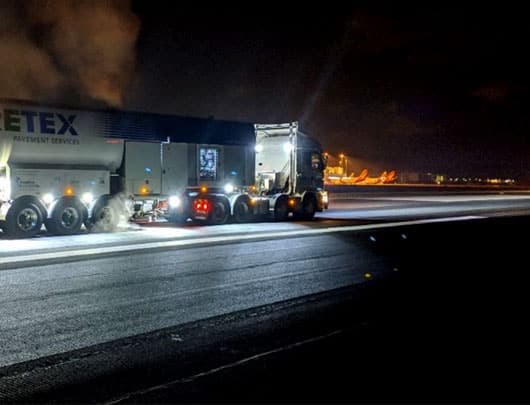
On the day, a vehicle tows a trailer-mounted runway friction tester along the runway in a series of passes. The tester uses the continuous wet-wheel method, with a measuring wheel running on a wetted surface and feeding friction values in real time to a computer in the towing vehicle.
Because measurement is continuous, the test records friction along the entire length of the runway rather than at sample points. The result reflects the condition of the surface end to end, including the touchdown zones where rubber concentrates.
For the operator, the main task is access. Testing is coordinated with airside operations around the aircraft movement schedule, and a trailer-mounted unit can test between movements. That keeps the runway available, avoids leaving static equipment on an active surface, and means testing does not usually require an extended runway closure.
What equipment does an airfield runway friction tester use?
An airfield runway friction tester is a continuous friction measuring device (CFME): a measuring wheel, usually fixed-slip, that records friction continuously as it is towed along the runway. RETEX uses certified trailer-mounted continuous friction testers, which measure along the full runway length in a single program of passes.
When engaging a contractor, ask whether the device is certified and approved for use against the standards that apply to your aerodrome. The report is only as useful as the device that produced the data, and an auditor will ask the same question.
What does a runway friction test report contain?
A runway friction test report contains measured friction values along the full length of the runway, plotted against the maintenance planning level and the minimum friction level that apply to your aerodrome. Sections falling below the planning level are flagged, so areas of concern are clear at a glance.
That structure is what makes the report useful. A section below the planning level is an early warning. The runway is still operating, but that area needs remediation scheduled before it becomes a compliance issue at the minimum level.
The report should arrive in a report-ready electronic format that your engineers and auditors can use without reworking the data. It feeds directly into pavement management programs, friction audits, safety cases, maintenance planning and post-rubber-removal verification.
What should you do with the results of a friction test?
What you do with the results depends on where each section sits against the maintenance planning level. Where the whole runway sits above it, the report becomes part of the asset record and the baseline for the next scheduled test.
Where sections fall below the planning level, the report tells you where to act. This is the practical value of testing: it verifies the surface and also locates the build-up that needs treatment, so remediation can be directed at the affected sections rather than the whole runway.
Where the cause is rubber build-up, the usual treatment is runway rubber removal. After removal, a follow-up friction test confirms the runway is back within specification and closes the loop for your records.
Testing, removal and re-testing are three stages of the same obligation. Using one contractor for all three keeps a single chain of accountability and reporting from audit to remediation to verification.
Which standards apply to runway friction testing in Australia?
Runway friction requirements for Australian aerodromes are set by the Civil Aviation Safety Authority (CASA) under its Part 139 aerodrome framework, with ICAO Annex 14 as the international reference.
Those documents define the friction levels that apply to a runway, the conditions that call for testing and the devices approved to measure against them. This guide deliberately does not restate any of those values. Standards are reviewed and updated, so check the current version of the source document before acting on any figure.
Planning a friction test for your aerodrome?
RETEX tests major and regional airports across Australia with teams in Western Australia, New South Wales and Queensland. Delivering friction testing and rubber removal as one managed program. See our runway friction testing service for how a program is scoped, or contact the team to talk through your requirements.
Want to see a completed project?
RETEX has completed friction testing at Canberra Airport and Gold Coast Airport. At Canberra, testing ran between aircraft movements, with the report delivered within 24 hours of testing. At Gold Coast, the scope combined friction testing with rubber removal at specified locations, under a maintenance plan for the runway.
